Why Your Blending Technology Choice Determines Product Success
Ever wondered why some spice blends taste perfectly balanced while others have pockets of overpowering flavor? The secret isn’t in the recipe—it’s in the blending technology.
The food industry faces an interesting paradox. While consumers demand increasingly complex flavor profiles and consistent quality, processors struggle to achieve uniform mixing without damaging delicate ingredients. Traditional mixing methods often fall short, leading to inconsistent products, customer complaints, and profit losses.
Enter the world of advanced blending solutions. Ribbon blender for spice mixing and paddle blender for ready-mix blends represent two powerful technologies that have revolutionized how processors achieve perfect homogeneity. But here’s what most equipment suppliers won’t tell you: choosing between them isn’t about which is “better”—it’s about matching technology to your specific product requirements.
Modern industrial food mixer with recipe automation capabilities transform blending from an art to a science. These systems deliver repeatability that manual processes simply cannot achieve. Whether you’re producing delicate tea blends or robust masala mixes, understanding these technologies empowers you to make investments that deliver measurable returns.
Your Next Step: Evaluate your current blending challenges. Are you dealing with segregation issues? Ingredient damage? Inconsistent batch quality? Identifying specific problems guides technology selection.
Understanding Ribbon Blenders: The Workhorse of Spice Processing
What Is a Ribbon Blender and How Does It Excel?
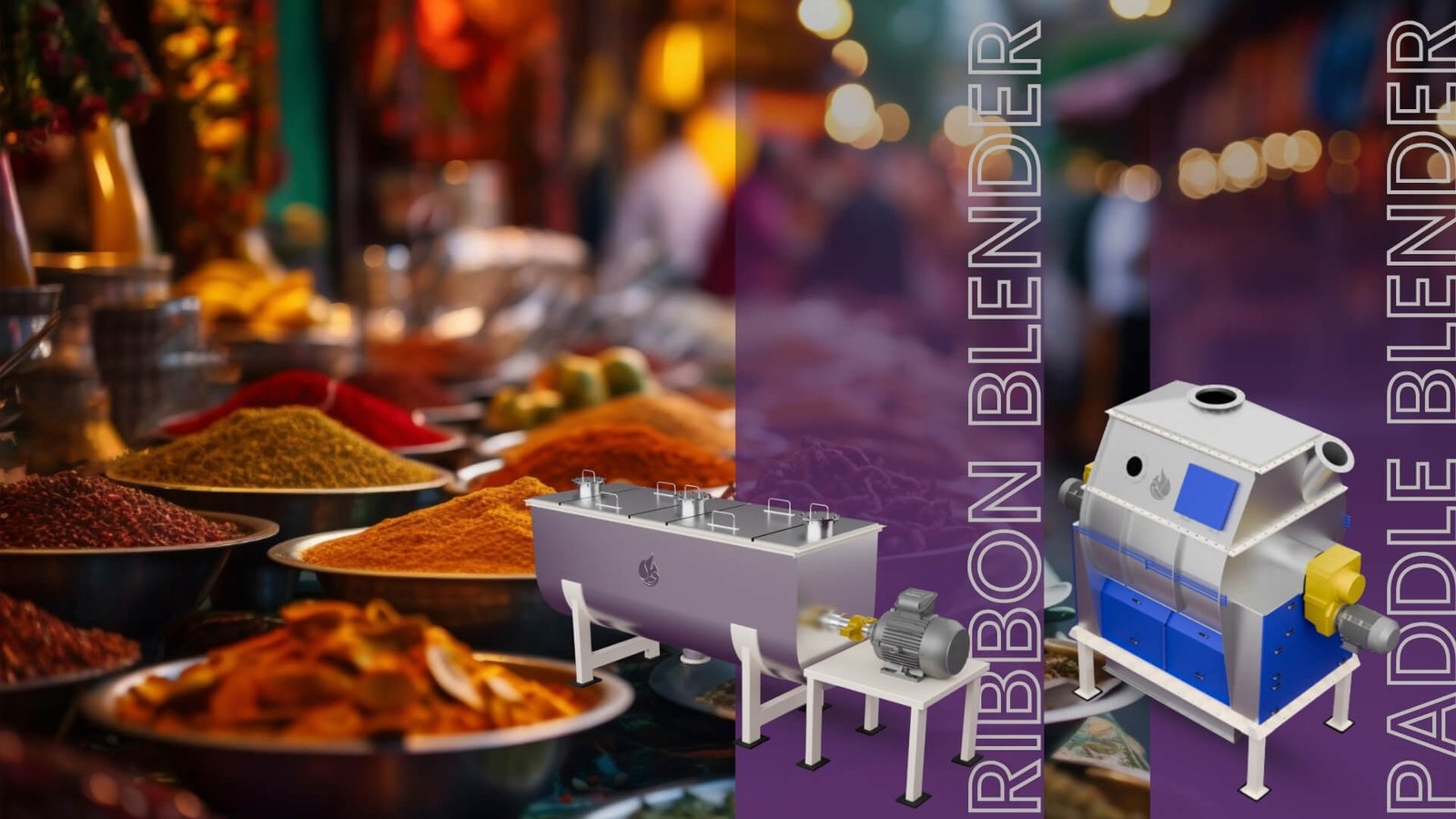
So what is a Ribbon Blender exactly? Picture a U-shaped trough with a precisely engineered double-helix ribbon rotating through it. This elegant design creates a unique mixing action that moves materials both radially and laterally, achieving remarkable uniformity.
The Ribbon Blender working principle relies on counter-current flow patterns. The outer ribbon moves materials in one direction while the inner ribbon moves them opposite. This creates a folding action that repeatedly divides and recombines your blend. Materials at the bottom get lifted to the top. Those at the ends move toward the center. Every particle travels through multiple mixing zones.
Ribbon Blender Manufacturers in India have refined this technology specifically for spice processing challenges. The gentle yet thorough mixing action preserves particle integrity while achieving coefficient of variation (CV) values that indicate exceptional uniformity.
This matters when your customers expect every teaspoon of seasoning to taste identical.
The construction of Ribbon Blender systems showcases engineering precision. Heavy-duty bearing assemblies support the ribbon shaft. Precisely machined clearances between ribbons and trough minimize dead zones. Food-grade stainless steel construction meets hygiene requirements. These details separate professional equipment from compromised alternatives.
Your Next Step: Calculate your blend uniformity requirements. Different applications demand different CV values—knowing your target helps evaluate blender performance.
Ribbon Blender Applications That Transform Operations
The versatility of Ribbon Blender for Food Processing extends across numerous applications. Dry spice blends achieve exceptional homogeneity. Coating applications distribute oils and flavors evenly. Even challenging materials like sticky ingredients blend successfully with proper ribbon configuration.
Ribbon Blender Applications in the spice industry demonstrate remarkable range. Garam masala production benefits from gentle mixing that preserves whole spices while distributing ground components. Tea blending operations use ribbon technology to combine delicate leaves without crushing. Seasoning manufacturers achieve precise salt distribution throughout complex blends.
Consider Ribbon Blender for Chemical Industry applications that parallel food processing. Pharmaceutical excipient blending requires similar uniformity standards. Nutraceutical powder mixing demands gentle handling. These cross-industry applications prove the technology’s reliability and versatility.
Leading Ribbon Blender Manufacturer Exporters like MillNest understand that success requires more than just equipment. Their systems incorporate decades of application expertise, ensuring your blender configuration matches your specific processing needs. This experience-driven approach eliminates costly trial-and-error periods.
Your Next Step: List your various blending applications and their specific requirements. This helps determine if a single ribbon blender can handle your entire product range.
Paddle Blender Technology: Precision Mixing for Sensitive Products
What Is a Paddle Blender and When Does It Outperform?
Understanding what is a Paddle Blender reveals why certain applications demand this technology. Unlike ribbon designs, paddle blenders use specially shaped paddles mounted on a rotating shaft to create a more aggressive mixing action with exceptional speed.
The Paddle Blender Working Principle generates high-intensity mixing zones. Paddles create fluidization that temporarily suspends particles, allowing rapid homogenization. This proves invaluable for products requiring quick color distribution or flavor encapsulation. The mixing intensity achieves results in minutes that might take ribbon blenders significantly longer.
Paddle Blender Manufacturer India companies have adapted this technology for specific food industry challenges. Instant drink mixes require rapid powder dispersion. Coating applications need immediate, uniform coverage. These demanding applications showcase paddle blender advantages.
The Industrial Paddle Blender Machine design emphasizes power and precision. Robust paddle configurations handle dense materials. Variable speed controls adjust mixing intensity. Quick-opening discharge valves minimize product retention. Every feature supports efficient, thorough blending.
Your Next Step: Identify products requiring rapid mixing or intensive blending action. These applications often justify paddle blender investment.
Advanced Applications for Paddle Blending Systems
Paddle Blender for Food Industry applications continue expanding as processors discover new capabilities. Ready-to-cook mixes benefit from paddle technology’s ability to distribute multiple ingredients uniformly. Fortified flour production uses paddle blenders to ensure even micronutrient distribution.
The Paddle Blender for Chemical Industry demonstrates cross-sector relevance. Pesticide formulations require absolute uniformity. Pigment blending demands rapid color distribution. These parallel applications inform food processing improvements.
Best Paddle Blender Manufacturer recognition comes from solving real-world challenges. MillNest’s approach involves understanding your complete process, not just the blending step. This holistic view ensures your paddle blender integrates seamlessly with upstream and downstream operations.
Paddle Blender Applications in premium product lines showcase quality advantages. Artisanal spice blends maintain distinct particle identities while achieving flavor harmony. Specialty tea blends preserve leaf appearance while ensuring consistent taste. These high-value applications justify technology investment through premium pricing.
Your Next Step: Calculate potential revenue increases from improved blend quality. Premium products often command price increases that rapidly offset equipment costs.
Low-Shear Solutions for Delicate Ingredients
Why Gentle Mixing Preserves Product Value
The low-shear blender for delicate ingredients addresses a critical challenge: achieving uniformity without damage. Many high-value ingredients—saffron strands, freeze-dried herbs, crystalline salts—lose value when broken or crushed.
Low-shear mixing preserves particle integrity through controlled motion. Instead of aggressive impact, materials flow gently together. This approach maintains visual appeal while ensuring flavor distribution. Your premium ingredients look and perform as intended.
Modern food-grade ribbon blender designs incorporate low-shear principles. Reduced ribbon speeds minimize particle attrition. Optimized ribbon pitch angles create gentle folding rather than aggressive cutting. These refinements protect delicate ingredients while maintaining mixing efficiency.
Ribbon Blender Supplier expertise proves invaluable when selecting low-shear solutions. Not all “gentle” mixing claims deliver actual results. Experienced suppliers like MillNest provide proven configurations for specific ingredient challenges, eliminating costly experimentation.
Your Next Step: Audit your ingredient damage rates. Even small reductions in waste or degradation significantly impact profitability.
Automation Benefits That Multiply Returns
The integration of industrial food mixers with recipe automation capabilities transforms blending from variable to predictable. Automated systems eliminate operator-dependent variations. Every batch follows programmed parameters precisely.
Recipe management systems store hundreds of formulations. Operators simply select the recipe, and the system handles everything—ingredient dosing, mixing time, speed control, discharge timing. This consistency builds brand reputation and customer loyalty.
Automation extends beyond basic control. Modern systems track ingredient lots for traceability. They document process parameters for quality assurance. They calculate real-time cost-per-batch for profitability analysis. These capabilities transform blending into a strategic advantage.
Paddle Blender Supplier companies increasingly offer automation-ready equipment. Pre-wired controls, sensor integration points, and communication protocols simplify automation implementation. This forward-thinking approach protects your investment as automation needs grow.
Your Next Step: Map your current recipe variations and batch frequencies. High-variation, high-frequency operations benefit most from automation.
Selection Guide: Matching Technology to Your Needs
Comparing Ribbon vs. Paddle Performance Metrics
Choosing between Ribbon Blenders: Working Principle, Types and Application and paddle alternatives requires understanding performance differences. Ribbon blenders excel at gentle, thorough mixing of free-flowing materials. Paddle blenders deliver rapid, intensive mixing for challenging applications.
Consider mixing time requirements. Ribbon blenders typically achieve uniformity in moderate timeframes with minimal heat generation. Paddle blenders mix faster but may generate more heat through friction. Your product’s heat sensitivity influences selection.
Power consumption varies significantly. Ribbon blenders generally require less power per unit volume. Paddle blenders trade higher energy use for faster processing. Calculate total energy costs based on your production schedules.
The advantages of ribbon blending include lower maintenance, gentler product handling, and excellent performance with varied batch sizes. Paddle advantages include faster mixing, better performance with cohesive materials, and superior liquid addition capabilities.
Your Next Step: Create a comparison matrix listing your specific requirements against each technology’s capabilities.
ROI Calculations That Justify Investment
Understanding Ribbon Blender Machine Price in India or Paddle Blender Machine Price in India represents just the starting point. True ROI calculations consider multiple factors beyond purchase price.
Labor savings through automation often provide fastest payback. Reducing operator time per batch by even minutes accumulates significant savings across multiple daily batches. Calculate your current labor cost per batch, then project automation savings.
Quality improvements generate substantial returns. Reduced rework, fewer complaints, and premium pricing for consistent products all contribute. Many processors report quality-related savings exceeding their monthly equipment payments.
The grinding mill buy back program and equipment trade in offer from suppliers like MillNest reduce initial investment. Your old equipment becomes credit toward new technology. This approach minimizes capital requirements while modernizing operations.
Energy efficiency improvements compound over time. Modern blenders with optimized designs and efficient motors reduce power consumption significantly. These savings continue throughout equipment life, improving long-term ROI.
Your Next Step: Build a comprehensive ROI model including all cost factors and benefit streams. This complete picture often reveals surprisingly fast payback periods.
Maintenance and Support: Ensuring Long-Term Success
Preventive Maintenance That Protects Your Investment
Blender reliability depends on systematic maintenance. Preventive maintenance contract food equipment programs ensure consistent performance while preventing costly breakdowns.
Daily inspections catch developing issues early. Check seal integrity, listen for unusual sounds, verify discharge valve operation. These simple observations prevent major failures. Documentation creates trending data that predicts maintenance needs.
The AMC for grinding mills concept extends naturally to blending equipment. Regular professional service maintains peak performance. Scheduled component replacement prevents unexpected failures. This proactive approach minimizes production disruptions.
Grinding mill spare parts India suppliers who stock blender components ensure rapid repairs when needed. Quick parts availability means shorter downtimes. MillNest’s comprehensive parts inventory supports both current and legacy equipment models.
Your Next Step: Establish a preventive maintenance schedule based on manufacturer recommendations and your production intensity.
Modernization Options for Existing Equipment
The food processing equipment modernization path doesn’t always require complete replacement. Strategic upgrades extend equipment life while adding capabilities.
Mill retrofit services India adapt to blending equipment needs. Control system upgrades add automation capability. Seal replacements improve hygiene. Variable speed drives enhance flexibility. These targeted improvements deliver new-equipment benefits at fraction of the cost.
Certified refurbished food processing equipment provides another modernization route. Professional refurbishment restores performance while incorporating improvements. MillNest Originals certified equipment undergoes comprehensive restoration, delivering like-new performance with warranty protection.
The old mill exchange offer and mill upgrade consultation India services help plan modernization strategies. Expert evaluation identifies improvement opportunities. Trade-in programs reduce upgrade costs. This systematic approach ensures maximum value from modernization investments.
Your Next Step: Schedule an equipment assessment to identify modernization opportunities that deliver highest returns.
Conclusion: Your Path to Blending Excellence
Selecting between ribbon and paddle blending technology isn’t about choosing the “best” option—it’s about matching capabilities to your specific needs. Both technologies offer distinct advantages that excel in appropriate applications.
Success starts with honest assessment. What are your product characteristics? What quality standards must you meet? What production volumes do you target? These answers guide technology selection.
Modern blending solutions from experienced Ribbon Blender Manufacturer & Supplier and Paddle Blender Manufacturer India companies like MillNest deliver more than equipment.
They provide application expertise, automation capabilities, and ongoing support that ensures long-term success.
Take action today:
- Evaluate your current blending challenges
- Define quality and efficiency targets
- Compare technology options against requirements
- Calculate comprehensive ROI projections
- Engage with experienced suppliers for guidance
Visit www.millnest.com to explore how advanced blending solutions transform your operations. Whether you need gentle ribbon blending for delicate spices or intensive paddle mixing for challenging applications, the right technology awaits.
Your competitors are already upgrading to advanced blending technology. Can you afford to fall behind?
Transform your blending. Elevate your products. Lead your market.