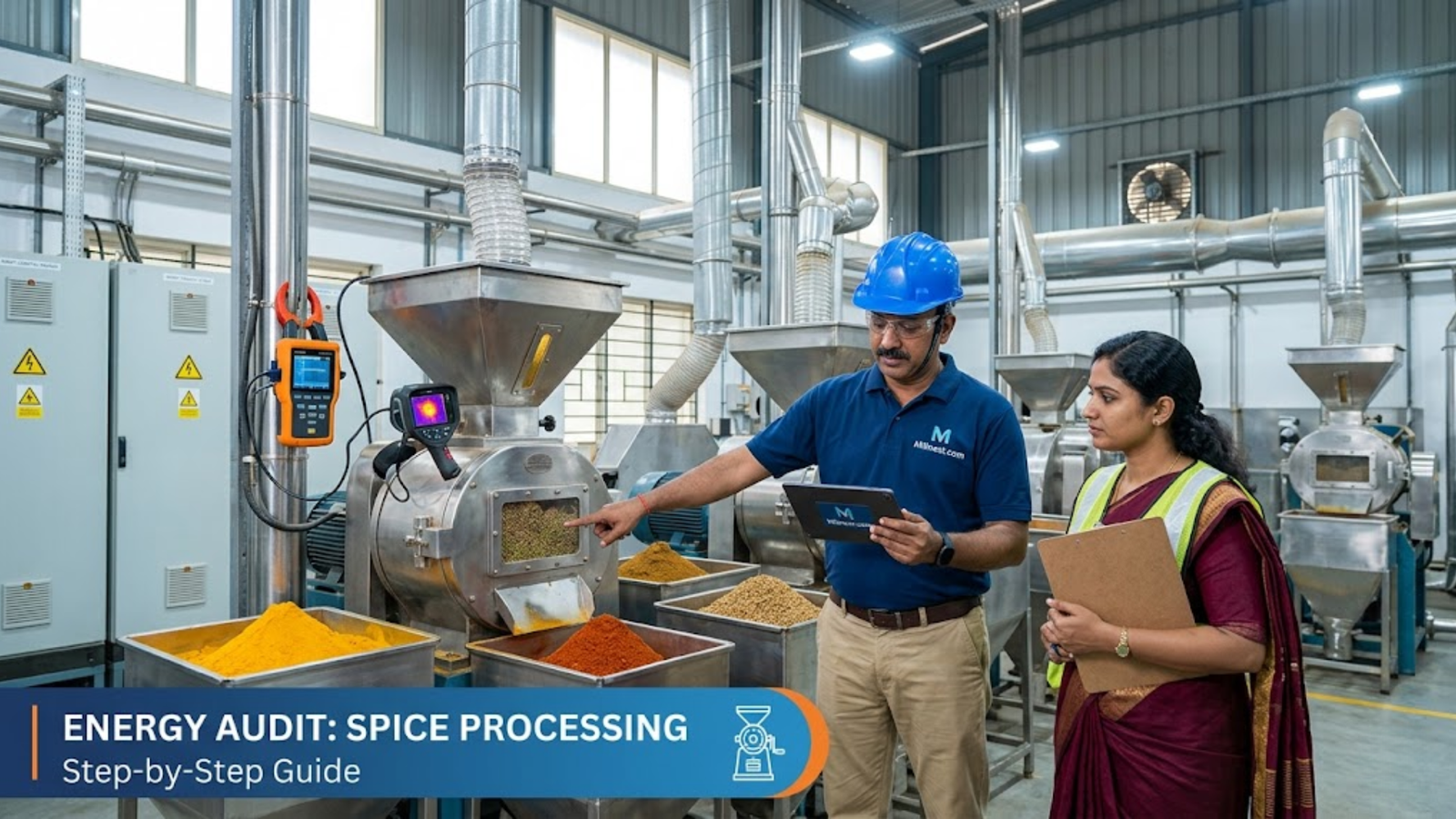
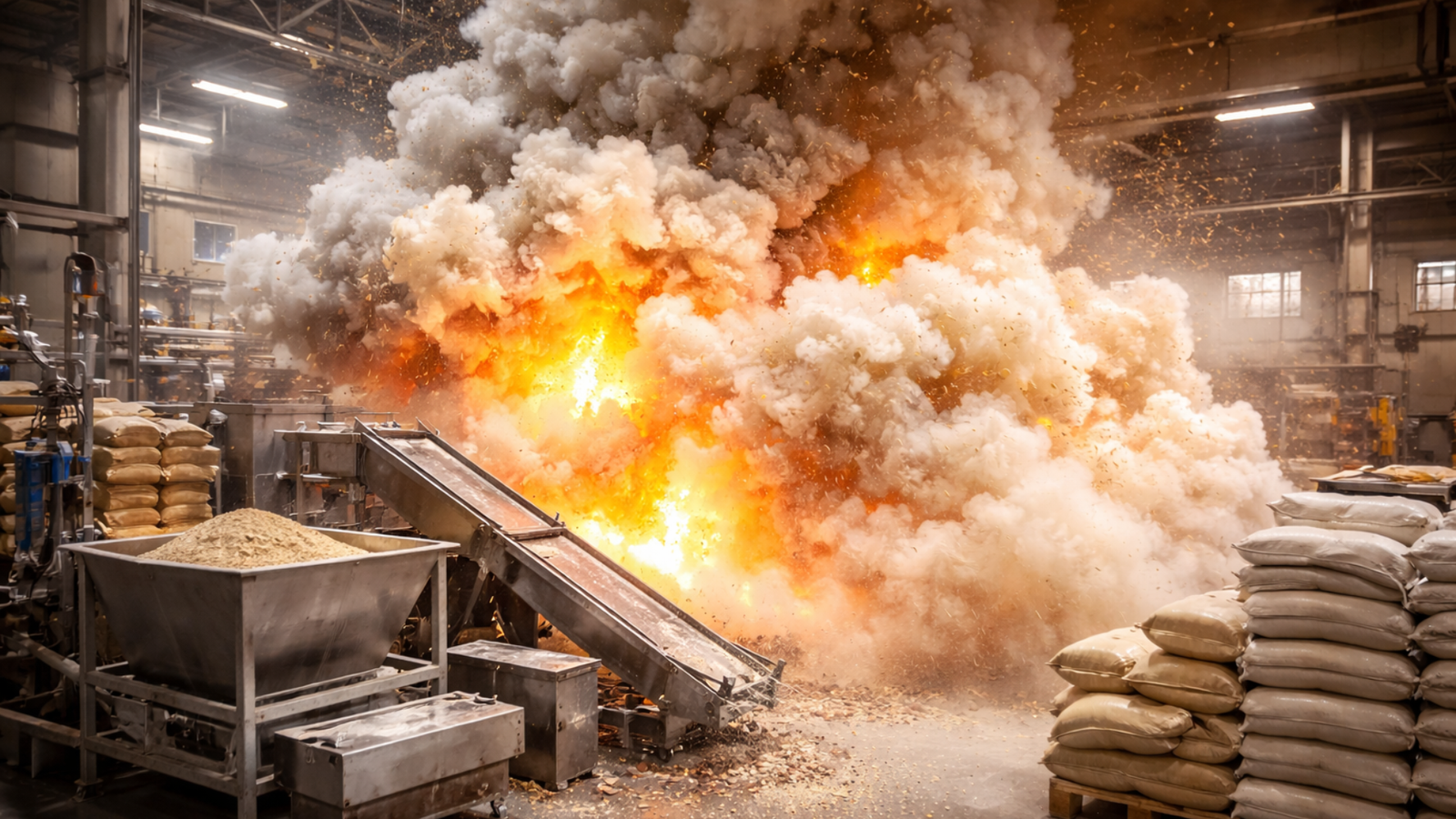
On 7 February 2008, a sugar refinery in Georgia, USA, experienced a catastrophic dust explosion that killed 14 workers and injured 36 more. The facility was not operating with flammable liquids or explosive chemicals. It was processing organic powder — material no more inherently dangerous to handle than the spices processed in thousands of Indian manufacturing plants every day.
Organic powder dust explosions are one of the most underestimated industrial hazards in food processing. They are also entirely preventable — when the right dust control spice processing systems are in place, the correct ATEX zone classifications are established, and explosion protection grinding equipment is specified for the operating environment.
This guide is written for safety officers and plant managers who need to understand the science behind spice dust explosion risk, the regulatory framework that governs it, and the engineering controls that eliminate it. It is not a theoretical safety document. It is a practical framework for facilities that process chilli, cumin, cardamom, pepper, turmeric, and the full range of dry spice materials that generate combustible dust under normal grinding and handling conditions.
⚠ FSSAI & Safety Authority Alignment FSSAI Schedule IV mandates that food processing facilities manage dust generation as a hygiene and safety control. The Factories Act 1948 (Section 36 – Explosive or Inflammable Dust) imposes legal obligations on occupiers of factories where combustible dust is generated. Non-compliance exposes plant management to criminal liability, not just regulatory penalties. |
Why Spice Dust Is a Classified Explosion Hazard
The explosive potential of a dust is determined by two physical characteristics: particle size and chemical composition. When organic material — including spices, herbs, and dried food ingredients — is ground to fine powder, the surface area-to-mass ratio increases dramatically. This creates a material that ignites and burns far more rapidly than the same substance in bulk form.
All commonly processed dry spices generate combustible dust during grinding, conveying, and packaging. Chilli powder, black pepper, cumin, coriander, turmeric, dried ginger, and cardamom have all been characterised as combustible dusts in international food safety literature. The specific hazard intensity varies by spice — but the classification as combustible dust applies across the category.
Three physical conditions make spice dust particularly hazardous compared to other food powders:
- Volatile oil content: The essential oils in high-aromatic spices (cardamom, black pepper, cloves) have low flash points. These volatile compounds, released during grinding and suspended in the dust cloud, reduce the minimum ignition energy required to initiate combustion.
- Fine particle generation: Modern food safety spice grinding equipment produces powders in the 50–500 micron range. Particles below 250 microns are considered most hazardous for dust explosion risk — a specification range that covers the majority of commercial spice grinding output.
- Hygroscopic behaviour: Spice powders absorb ambient moisture when dust control systems are inadequate, creating surface conditions that can concentrate combustible material on equipment walls, creating secondary explosion risk from settled dust.
The Dust Explosion Pentagon: Five Conditions That Must Coexist
Understanding dust explosion risk requires understanding the dust explosion pentagon — an extension of the fire triangle that defines the five simultaneous conditions required for a dust explosion event. Remove any single element and explosion cannot occur. Allow all five to coexist and the consequences can be catastrophic.
Pentagon Element | What It Means | In Spice Processing | Control Strategy |
Fuel | Combustible dust particles | Spice powder at all processing stages | Dust-free processing; containment; housekeeping |
Oxidiser | Oxygen in ambient air | Present in all open processing environments | Inerting with N₂ in high-risk zones; sealed systems |
Ignition | Spark, hot surface, static discharge, open flame | Friction sparks from mills; static in pneumatic lines | ATEX certified processing equipment; earthing; hot work controls |
Dispersion | Dust suspended as airborne cloud | Mill discharge, conveying, bag filling | Explosion protection grinding design; enclosed transfer |
Confinement | Enclosed space where pressure can build | Mill housings, ducts, cyclones, bag filters | Explosion venting; suppression systems; isolation valves |
Source: NFPA 652 Standard on the Fundamentals of Combustible Dust; EN 14460 Explosion-Resistant Equipment.
The practical implication for plant managers: dust control spice processing systems must address all five pentagon elements simultaneously. A facility that installs excellent ignition suppression equipment but neglects dust containment at conveying transfer points has addressed one element while leaving four others active. That is not compliance. That is incomplete protection.
ATEX Zone Classification for Spice Processing Facilities
ATEX (ATmosphères EXplosibles) is the European regulatory framework — and the global industry standard — for classifying zones where explosive dust atmospheres may be present and specifying equipment for use in those zones. While ATEX is European legislation, its zone classification system is adopted by Indian industrial safety standards, IS:5572 and IS:6229, and referenced in FSSAI compliant spice processing facility design guidelines.
For dust (as opposed to gas), three zone classifications apply:
Zone | Definition | Typical Locations | Equipment Category |
Zone 20 | Explosive dust cloud present continuously or for long periods | Inside mill housings, dust collectors, pneumatic conveying lines | Cat. 1D equipment mandatory (highest protection) |
Zone 21 | Explosive dust cloud likely during normal operation | Mill discharge points, bag-filling areas, sieving zones | Cat. 1D or 2D equipment (EN 13463-1) |
Zone 22 | Explosive dust cloud unlikely but possible under abnormal conditions | Surrounding areas, packing halls adjacent to grinding zones | Cat. 2D or 3D equipment acceptable |
A critical compliance point: zone classification must be formally documented in a site Dust Hazard Assessment (DHA) and reviewed whenever processing operations, raw material types, or facility layout change. For FSSAI compliant spice processing facilities, this document is expected to be available for inspection during regulatory and third-party safety audits.
Dust-Specific Risk Data: Spice MEC and Kst Values
Two parameters quantify the explosion severity of a specific dust: Minimum Explosible Concentration (MEC) and the deflagration index Kst. Understanding these values is essential for specifying explosion protection grinding equipment and sizing suppression or venting systems correctly.
Spice | MEC (g/m³) | Kst (bar·m/s) | Dust Class | Practical Implication |
Black Pepper | 30–60 | 100–160 | St 1 | Zone 21 at discharge; standard venting adequate |
Chilli Powder | 40–70 | 80–130 | St 1 | Volatile oil content raises ignition sensitivity |
Cardamom | 20–40 | 130–200 | St 2 | Higher Kst: enhanced suppression or venting required |
Cumin | 35–65 | 90–140 | St 1 | Standard Zone 21 equipment; DHA required |
Turmeric | 50–80 | 70–110 | St 1 | Lower Kst relative to aromatic spices; standard systems sufficient |
Coriander | 40–75 | 85–135 | St 1 | Grinding of coriander produces fine dust — dust-free processing essential |
Note: MEC and Kst values are indicative ranges from published literature (GESTIS-DUST-EX database; BIA Report 13/97). Actual values depend on particle size, moisture content, and temperature. Site-specific testing recommended for venting system design.
FSSAI and Indian Regulatory Requirements for Dust Control
FSSAI compliant spice processing facilities must address dust generation under two overlapping regulatory frameworks. Understanding both — and the specific obligations they create — is essential for plant managers and safety officers preparing for audits.
FSSAI Schedule IV — Manufacturing and Processing
Schedule IV requires that food processing facilities prevent contamination from airborne particles including dust, and that processing areas maintain hygienic conditions that prevent cross-contamination between products. For spice mills, this directly mandates dust control spice processing systems capable of containing fine particulates at source, before they can settle on product-contact surfaces, packaging materials, or open product streams.
Factories Act 1948 — Section 36: Dust and Fumes
Section 36 requires occupiers of factories where dust, gas, or fumes are generated to take measures to prevent accumulation in workrooms and inhalation by workers. For combustible dusts, this obligation extends to preventing dust cloud formation that could constitute an explosion hazard. Compliance is enforced by the state Factories Inspector, and non-compliance with safety provisions can result in prosecution of the factory occupier.
IS:5572:2009 and IS:6229: Hazardous Zone Classification
Indian Standard IS:5572 classifies hazardous locations for electrical equipment selection, directly incorporating the ATEX zone framework for dust. IS:6229 specifies dust-ignition-proof construction for electrical equipment. Taken together, these standards require that all electrical equipment in Zone 20 and Zone 21 areas of a spice mill be ATEX certified processing equipment or equivalent, with specific design protection (IP6X enclosures as minimum, temperature class T₂–T₃ for most spice dusts).
Explosion Protection Grinding: Equipment Design Requirements
Explosion protection grinding equipment is not simply standard food safety spice grinding equipment with an ATEX label. True explosion-rated design requires structural, electrical, and mechanical interventions that fundamentally change how equipment handles the energy released in a deflagration event.
For Zone 20 and Zone 21 equipment, the following design elements are mandatory:
- Explosion-pressure-resistant construction: Equipment housings must be rated to withstand the maximum internal pressure of a contained deflagration without catastrophic failure. For St 1 dusts in typical mill configurations, this requires equipment rated to a minimum 10 bar static pressure.
- Explosion venting (EN 14491): Where pressure-resistant construction is impractical, explosion vents provide controlled pressure relief to the exterior of the building through ducts. Vent sizing is calculated from the equipment volume and the Kst value of the specific dust being processed.
- Flameless explosion venting (where internal explosion must be contained): Flameless venting devices allow pressure relief while retaining the flame front within a filter element — critical for indoor installations where exterior venting is not feasible.
- Chemical suppression systems: Pressure detectors trigger high-speed injection of suppression agent (typically dry chemical or water mist) within milliseconds of deflagration initiation — before pressure reaches destructive levels.
- Explosion isolation: Fast-acting valves or chemical barriers in duct connections between equipment prevent propagation of the deflagration from one vessel to adjacent equipment in the processing line — preventing the secondary, larger explosion that causes the majority of fatalities.
- Electrostatic grounding: All ATEX certified processing equipment in dust-handling applications must be bonded and earthed to prevent static discharge exceeding the minimum ignition energy of the dust being processed.
MillNest Dust Control Solutions
Effective dust control spice processing requires an integrated system architecture — not a single piece of equipment. MillNest’s approach combines primary containment at source, secondary collection, tertiary filtration, and explosion protection as designed-in features, not retrofits.
Integrated Aspiration Systems on Grinding Equipment
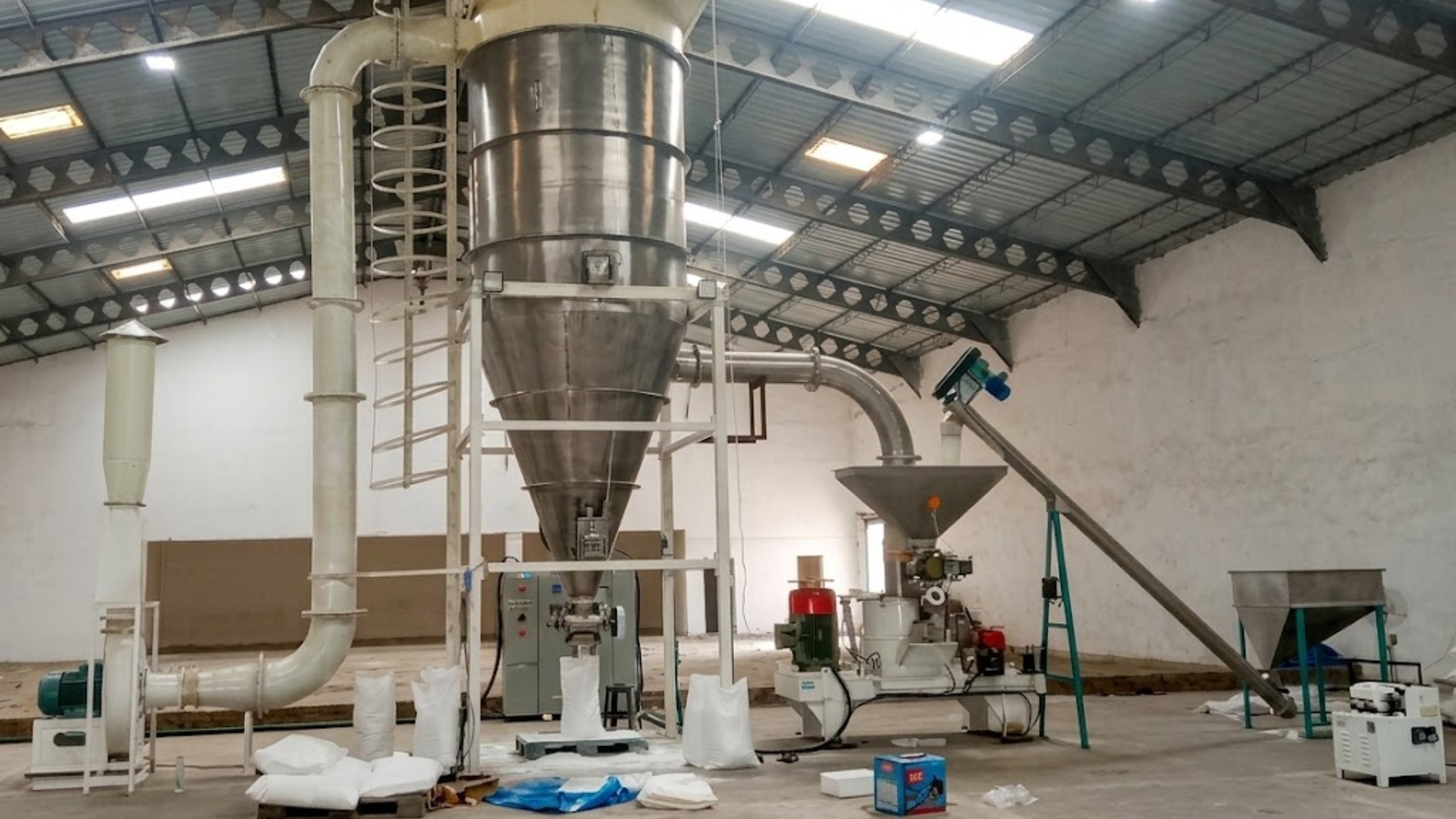
MillNest hammer mills, air classifying mills, and universal mills are designed with integrated aspiration ports that capture fine particles at source — before they enter the ambient air of the processing hall. Negative pressure at the mill discharge prevents dust escape during normal operation and dramatically reduces the Zone 21 footprint around grinding equipment. This is the single highest-impact dust-free processing intervention available at the equipment level.
Pulse-Jet Bag Filter Dust Collectors
MillNest’s pulse-jet bag filter collectors provide high-efficiency particulate collection with continuous cleaning cycles that maintain consistent collection efficiency without manual intervention. Critical design features for explosion protection include: explosion vent panels sized to the process Kst value, earthed filter bags with antistatic construction to prevent internal static accumulation, and rotary airlocks that provide explosion isolation between the filter vessel and downstream ducting.
Cyclone Pre-Separators
For high-dust-load applications, cyclone pre-separators remove the bulk of coarse particulate before the dust stream reaches the bag filter — reducing filter loading, extending filter life, and reducing the mass of combustible dust held in suspension within the collection system at any time. This directly reduces the severity of any deflagration event within the collector vessel.
Sealed Pneumatic Conveying Integration
Integrating dust control with sealed pneumatic conveying eliminates open transfer points — the highest-risk dust dispersion locations in conventional spice processing lines. MillNest’s integrated line designs ensure that product moves from mill discharge to blender or packaging inlet through fully enclosed, earthed, and pressure-rated transfer systems, maintaining dust-free processing throughout the production sequence.
Prevention System Architecture: Defence in Depth
Industrial safety engineering applies the defence-in-depth principle: multiple independent layers of protection, each capable of preventing harm even if other layers fail. For spice mill dust explosion prevention, the architecture has five layers:
Layer | Control Type | Implementation | Standard |
1 | Inherent prevention | Sealed processing; integrated aspiration; dust-free processing design | ATEX Directive; FSSAI Sch. IV |
2 | Detection | Pressure sensors; spark detection systems at mill inlets and duct elbows | EN 26184; NFPA 654 |
3 | Suppression | Chemical suppression on detection signal; response <30 ms | EN 14373 |
4 | Containment | Explosion venting (EN 14491); pressure-resistant equipment housings | EN 14460; EN 14491 |
5 | Isolation | Fast-acting isolation valves; rotary airlocks; decoupled vessel design | EN 15089 |
Implementation Checklist for Safety Officers and Plant Managers
Use this checklist as the starting framework for a site dust explosion prevention review. Each item corresponds to a documented compliance obligation under ATEX, IS:5572, FSSAI Schedule IV, or the Factories Act.
- Complete a formal Dust Hazard Assessment (DHA) covering all process stages where combustible dust is generated, handled, or conveyed
- Establish and document ATEX zone classification drawings for all grinding, conveying, collection, and packaging areas
- Audit all electrical equipment in Zone 20 and Zone 21 areas against IS:6229 / ATEX category requirements
- Verify that all grinding equipment has integrated aspiration and that explosion protection grinding specifications (pressure rating, venting, suppression) are documented
- Inspect and verify dust-free processing integrity at all conveying transfer points — eliminate open transfers in Zone 21 areas
- Confirm explosion vent sizing calculations are available for all enclosed dust-handling vessels (baghouse collectors, cyclones, storage hoppers)
- Verify that all conducting parts of the dust handling system are bonded and earthed, with earth resistance testing records available
- Review housekeeping protocols: settled dust on elevated surfaces is a secondary explosion risk that is often as significant as primary ignition risk
- Ensure that hot work permits are in force for any welding, cutting, or grinding activities within Zone 21 areas, and that permits include dust hazard controls
- Confirm that FSSAI compliant spice processing documentation includes dust control system specifications and maintenance records available for audit
The Safety Investment That Protects Everything Else
The regulatory and safety case for explosion-rated dust control spice processing systems is unambiguous. The engineering solutions are well-established. The standards — ATEX, IS:5572, NFPA 654, EN 14460 — provide clear specifications for every equipment and system requirement. What remains is the management decision to implement them.
A dust explosion in a spice processing facility does not just destroy equipment. It destroys production capacity, regulatory standing, export certifications, and in the worst cases, it costs lives. The cost of prevention — explosion protection grinding equipment, integrated dust-free processing systems, ATEX certified processing equipment for electrical installations — is quantifiable, amortisable, and recoverable in reduced insurance premiums, improved audit outcomes, and uninterrupted production.
The cost of the alternative is not.
MillNest designs and supplies dust control spice processing systems, explosion-rated grinding equipment, and integrated safety-compliant processing lines for FSSAI and ATEX-aligned facilities. Download our Dust Hazard Assessment Checklist or book a safety engineering consultation with the MillNest team. www.millnest.com • namaste@millnest.com • +91 73300 00371 |