Modernise Your Spice Plant on a Budget. Here is the situation most mid-size spice processors are navigating right now.
Buyers — whether organised retail, QSR chains, or export markets — are asking harder questions about your facility. FSSAI audit standards have tightened. Your competitors are quoting lower prices on the same product categories. And somewhere on your plant floor, there is a machine that is costing you more per month in downtime, rework, and excess power consumption than you have formally calculated.
The answer to all of this is modernisation. Better equipment, better controls, better compliance posture.
The problem: your capex budget does not look like the problem requires.
This is not a niche situation. It is the operating reality for the majority of Indian spice processing SMEs — businesses running plants with 8 to 25 machines, trying to upgrade infrastructure while simultaneously funding raw material inventory, working capital, and growth.
The good news is that spice processing plant modernisation does not require a large upfront commitment if you approach it in the right sequence. This framework gives you that sequence — five steps, ordered by ROI speed and capital efficiency, designed to work within the budget constraints you actually have.
The Core Principle: Sequence Determines ROI
Before the five steps, one principle worth internalising: the order in which you spend matters as much as the amount you spend.
Most plant owners who overspend on modernisation do so not because they chose the wrong equipment — but because they spent in the wrong order. They replaced machines that maintenance would have restored. They added capacity to lines where the real bottleneck was upstream. They invested in compliance upgrades before fixing the throughput issues that were eroding the margin those upgrades were supposed to protect.
A budget modernisation approach works because it front-loads the highest-ROI actions and uses the returns from early steps to fund later ones. By Step 4, a well-sequenced plant is partly self-financing its own upgrade programme.
Step 1: Audit Your Line — Find the Money Before You Spend It
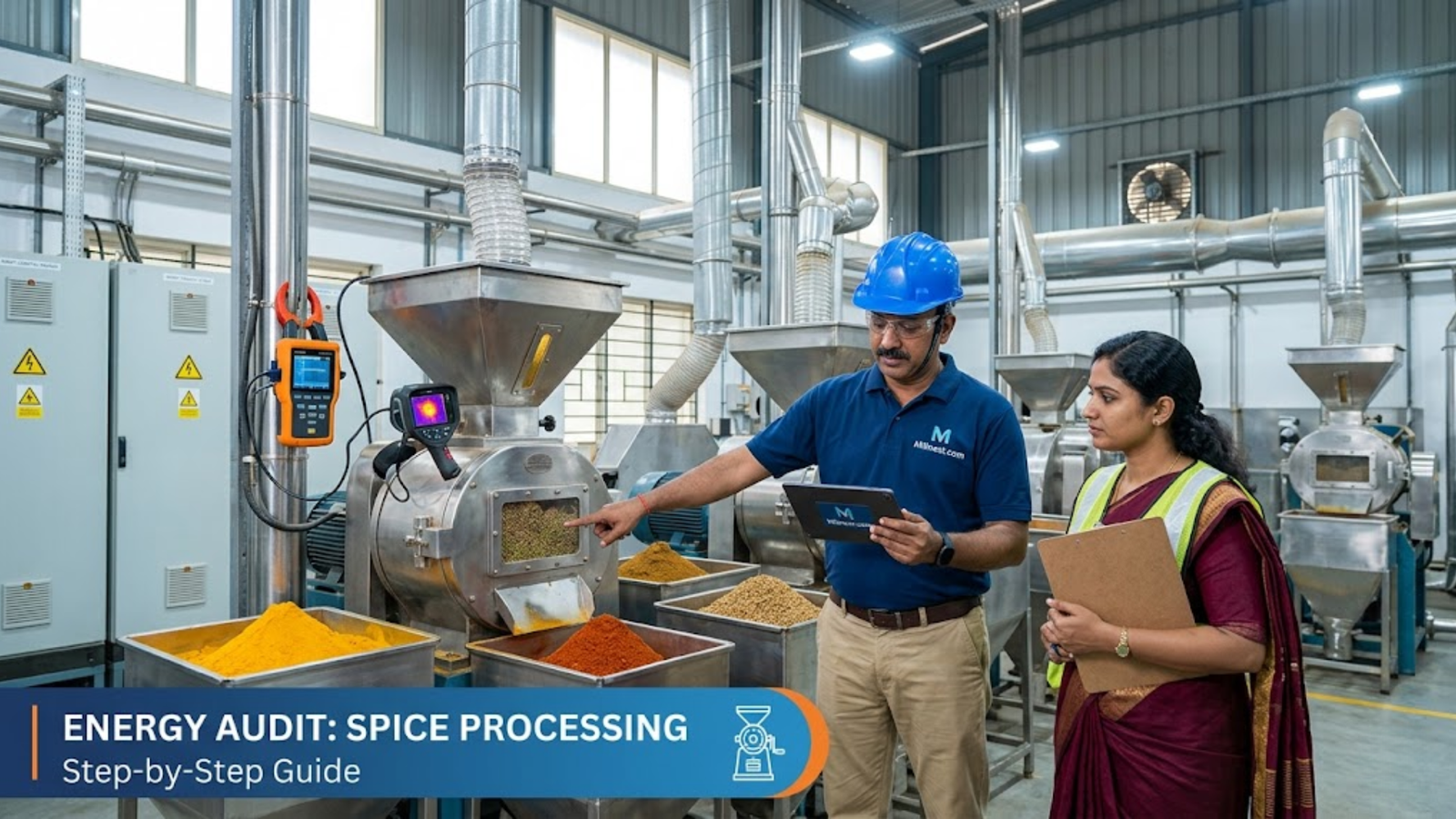
The action: Before spending anything on any upgrade, spend two to three days mapping where your current plant is losing money.
This sounds obvious. Almost nobody does it rigorously.
The audit has three components:
Throughput loss mapping. For each machine on your primary processing line, record actual output against rated output over a full production week. A machine running significantly below its rated capacity is not “running fine” — it is losing you a proportional share of the output you paid for, every shift it operates. Identify the two or three machines with the largest throughput gaps. These are your highest-priority targets.
Downtime cost calculation. Take your last three months of maintenance records and convert unplanned downtime into a rupee cost: lost production hours multiplied by your margin per hour of output. For most SME spice processors, this number is consistently higher than the owner estimates before they calculate it formally.
Energy consumption baseline. Check your electricity bills against your machine inventory. High-consumption machines running on degraded motors or misaligned drive systems routinely draw 15–30% more power than their specification requires. Across a full month of production shifts, that excess consumption adds meaningfully to your per-kg cost.
The audit output is a ranked list: which machines are costing you the most, and why. Everything that follows in this framework is driven by that list — not by which machine looks oldest or which supplier calls most frequently.
Budget allocation for Step 1: Zero cash outlay if done internally. A modest external investment if you bring in an engineering team to conduct the assessment formally. The MillNest Engineering Team offers a structured line audit as part of the Modernisation Toolkit programme → — it includes a written report with a ranked priority list and indicative investment figures for each intervention.
Step 2: Start With Wear Parts — The Fastest ROI in the Plant
The action: Replace grinding elements, bearings, seals, and drive components on your highest-loss machines before considering any other upgrade.
This is the step most plant owners skip — not because they don’t know about it, but because it feels too simple. Replacing hammers and screens doesn’t feel like modernisation. It feels like maintenance.
The distinction matters less than the result. A pulveriser running on worn hammers and a degraded screen is typically operating at 55–70% of its rated throughput and drawing excess power. Replacing those components restores 80–95% of rated capacity from the first shift after the work is done.
The payback window on wear parts replacement is among the fastest of any plant intervention available. It is typically measured in weeks, not months — and that speed is precisely why it comes first in a budget-constrained modernisation plan.
The incremental improvement principle applies directly here: you are not adding new capability, you are recovering capability you already paid for and have been slowly losing. For budget-constrained processors, this is the correct first deployment of capital — not because it is the most exciting investment, but because nothing else pays back as fast.
What to cover in Step 2:
- Grinding elements (hammers, blades, screens) on all pulverisers and mills
- Bearing assemblies on high-run machines
- All seals and gaskets on product-contact equipment
- Belt and pulley alignment checks and replacements where needed
- Conveyor and feeder components where wear is causing feed inconsistency
Budget allocation for Step 2: 20–25% of your total modernisation budget. The returns from this step typically begin funding Steps 3 and 4 within a few months of completion.
Step 3: Add Controls Before Capacity — Digital Upgrades Pay Back in 12–18 Months
The action: Upgrade monitoring, instrumentation, and control systems on your core machines before spending on capacity expansion.
This is the step where most plant owners get the sequence wrong. The instinct when throughput is constrained is to add capacity — buy a bigger machine, add a second unit, push for higher output. Before doing any of that, add visibility.
Here is why the sequence matters: without accurate data on where your line is losing time and efficiency, capacity additions often solve the wrong problem. A new pulveriser does not help if the bottleneck is actually at the grader downstream. A higher-capacity blender does not improve output if feed inconsistency at the intake is the limiting factor.
Controls upgrades for a mid-size spice plant typically involve:
Basic instrumentation: Temperature sensors, RPM monitors, and pressure gauges on machines that currently have none — or have failed instruments that have never been replaced. Low-cost interventions with immediate impact on operator decision-making.
Variable Frequency Drives (VFDs): Installing VFDs on existing motors allows precise speed control, reduces energy consumption by 15–30% on variable-load applications, and extends motor life. Payback at current electricity tariffs is typically achieved within 10–16 months — making this one of the strongest ROI interventions available to a budget-constrained processor.
PLC-based control panel upgrades: Replacing ageing relay-based or analogue panels with PLC systems adds alarm management, basic data logging, and consistent operator interfaces. Compatible with virtually any existing machine frame.
Entry-level condition monitoring: Vibration sensors on high-value machines provide early warning of developing bearing or shaft issues — converting unplanned failures into planned maintenance and removing the largest single source of production loss in most spice plants.
The combined effect of these upgrades is a plant that generates data, reduces energy waste, and surfaces developing problems before they become production stoppages. That foundation makes every subsequent investment decision more precise — and more justifiable to lenders or investors if modernisation financing is part of your plan.
Budget allocation for Step 3: 25–30% of your total modernisation budget, staged across several months.
Step 4: Use MillNest Originals for Expansion — New-Spec Performance at a Fraction of New Cost
The action: When your audit and steps 2–3 confirm that a machine genuinely needs replacement or that you need additional capacity, source through MillNest Originals rather than defaulting to new equipment.
By Step 4, you have accurate data on which machines have reached genuine end-of-life versus which were underperforming due to maintenance gaps. That distinction — which Steps 1 through 3 make possible — is what enables smarter purchasing decisions at this stage.
MillNest Originals is a structured equipment refurbishment programme that delivers professionally restored spice processing machines at 35–45% of new equivalent cost. Every machine goes through a full six-stage overhaul — strip, assess, replace, rebuild, test, commission — and carries a 12-month workmanship warranty.
The performance specification of a MillNest Originals machine is equivalent to new — because every component that affects output, food safety, or compliance has been replaced. What is retained is the structural frame — the most expensive component to manufacture — which has been assessed and certified as within tolerance.
For processors at Step 4, the capital efficiency implication is direct: the same budget that covers one new machine can cover multiple Originals units. That difference compounds across a multi-machine upgrade programme and is the primary reason MillNest Originals fits naturally into a budget modernisation sequence at this stage.
Browse the MillNest Originals Programme →
Budget allocation for Step 4: 30–35% of your total modernisation budget — typically the largest single allocation, but deployed after Steps 1–3 have already generated returns that partially offset it.
Step 5: Phase Compliance Upgrades With Your Export and Retail Milestones
The action: Time your compliance investments to land 3–4 months before the customer or regulatory milestone that requires them.
Compliance upgrades — food-contact surface changes, dust containment systems, traceability documentation, hygiene design modifications — are non-negotiable eventually. But the timing of when you invest in them has a significant impact on whether those investments deliver revenue uplift or simply add to your cost base.
The practical approach:
Map your compliance triggers. List the specific certifications, audit standards, or buyer requirements you are targeting over the next 18–24 months. FSSAI licence renewal, export market certification, a specific retail chain’s supplier qualification programme. Each has a timeline.
Work backwards 3–4 months. That is your compliance upgrade window for each milestone. Early enough to pass the relevant audit or inspection. Late enough that the investment is connected to a specific commercial outcome rather than abstract future-proofing.
Prioritise by revenue impact. A compliance upgrade that unlocks a significant export relationship pays back in a fundamentally different way than one that addresses an FSSAI observation with no immediate commercial consequence. Sequence accordingly.
Common Step 5 investments:
- SS304/SS316 food-contact surface upgrades or liners
- Positive pressure air handling for higher-grade facilities
- Batch traceability system (manual or semi-digital depending on scale)
- Dust containment compliance upgrades
Budget allocation for Step 5: 15–20% of your total modernisation budget, staged against specific commercial milestones rather than deployed all at once.
The Budget Allocation Summary
Step | Focus Area | Budget Allocation | Typical Timing |
Step 1: Audit | Line assessment | 0–5% | Month 1 |
Step 2: Wear Parts | Grinding elements, bearings, seals | 20–25% | Months 1–3 |
Step 3: Controls | VFDs, sensors, panel upgrades | 25–30% | Months 3–7 |
Step 4: Originals | Refurbished equipment for replacement/expansion | 30–35% | Months 7–14 |
Step 5: Compliance | Surface upgrades, traceability, dust containment | 15–20% | Months 10–18 |
The total does not need to be committed upfront. Steps 2 and 3 should be substantially self-funding by the time Step 4 capital is required — which is why the sequence is as important as the allocation percentages themselves.
One More Thing: Modernisation Financing
If your modernisation budget is genuinely constrained, phased financing is worth exploring alongside the phased spending plan.
Several MSME-focused equipment lending programmes from SIDBI, NSIC, and select NBFCs are structured specifically for food processing plant upgrades. The phased modernisation plan this framework generates serves as the project documentation those lenders typically require — milestone-based drawdowns, defined ROI benchmarks, and a structured repayment horizon tied to efficiency gains.
The MillNest Modernisation Toolkit includes a financing guidance note covering the schemes most relevant to spice processing SMEs, with indicative eligibility criteria and application requirements.
Download the Free MillNest Modernisation Toolkit →
The toolkit also includes the full Retrofit Feasibility Checklist, ROI Calculator, and Phased Modernisation Planner referenced across this framework.
The Bottom Line
Modernising a spice plant on a tight budget is not about finding cheaper shortcuts. It is about sequencing correctly so that every rupee you spend generates the return that funds the next step.
Audit first. Fix wear before adding capacity. Add visibility before adding machines. Source smart at the expansion stage. Time compliance to commercial milestones.
That sequence works whether your total budget is modest or substantial. The scale changes. The logic does not.
Published by the MillNest Engineering Team. For plant-specific guidance, request a free line audit through MillNest Academy or contact our engineering team directly.