In most spice processing plants, energy is one of the largest controllable costs — and one of the least examined. The electricity bill arrives, it gets paid, and the number is treated as a fixed cost of doing business. But energy is not fixed. It’s the sum of hundreds of decisions about how equipment is run, maintained, sized, and laid out, and a meaningful share of it is being spent on work that produces no sellable output.
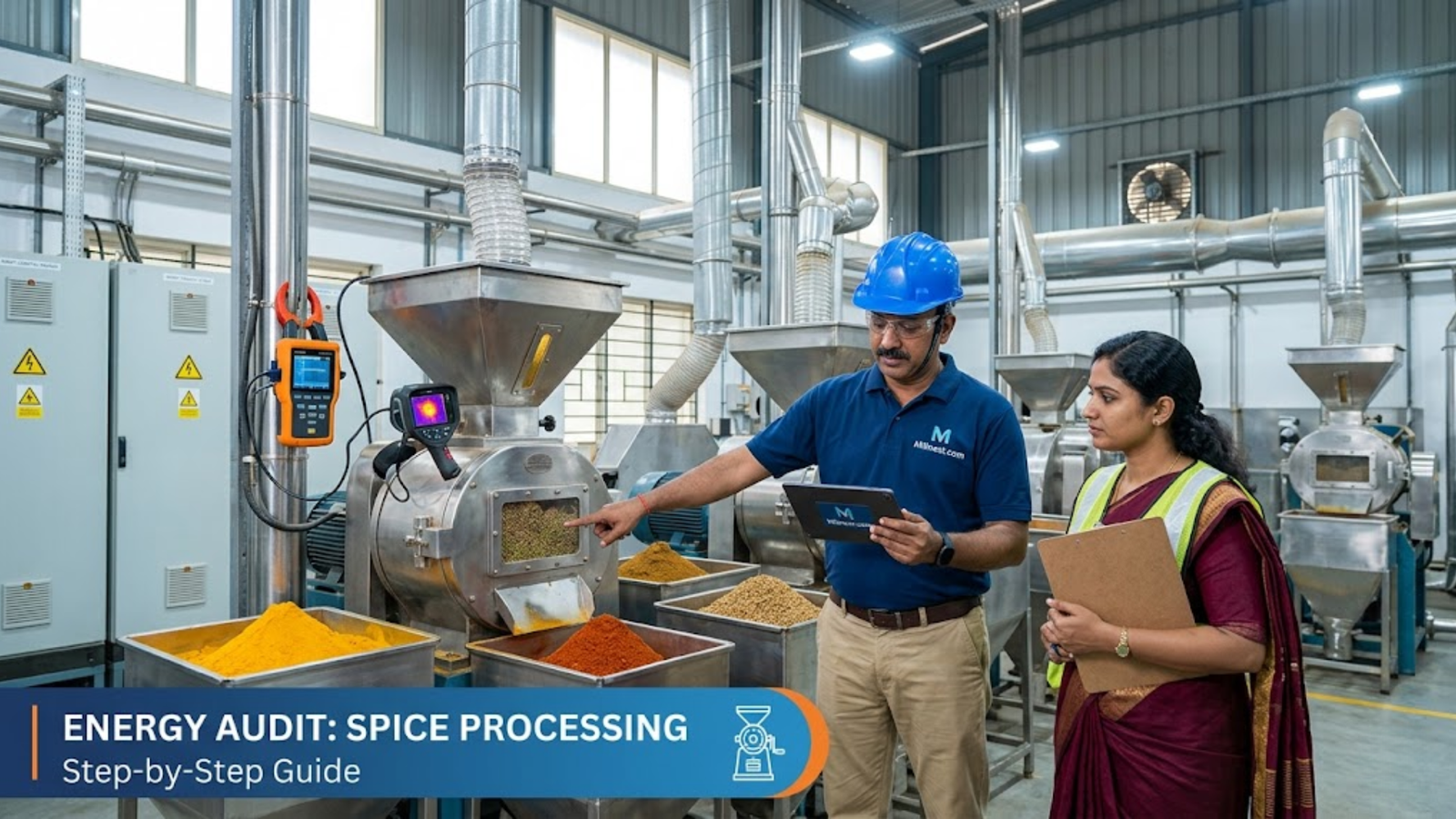
The way to find that wasted spend is an energy audit. You don’t need an external consultant or specialised instruments to begin — a plant team with a clamp meter, a notebook, and a disciplined approach can surface most of the recoverable savings on its own. This guide walks through how to run that audit step by step, and what to do with what you find.
Why energy hides in a spice plant
Energy waste is hard to see because it doesn’t announce itself. A mill drawing more power than it should looks identical to one running efficiently. A motor running at full load during a demand peak costs more than the same motor running off-peak, but the meter on the wall doesn’t separate the two. Heat pouring out of an exhaust is energy you generated and then threw away, but nothing on the floor flags it.
An energy audit makes the invisible visible. The goal is simple: understand where every unit of energy goes, identify where it’s being wasted, and rank the fixes by return. Done properly, it turns energy from a fixed cost into a managed one — and energy-efficient spice processing starts with exactly this kind of visibility.
Step 1: Map energy consumption by equipment zone
You can’t improve what you haven’t located. Begin by breaking the plant into logical energy zones rather than treating it as one big load. In a typical spice plant these zones are size reduction (hammer mills, classifying mills), blending, conveying and de-dusting, sterilization or drying if present, and utilities such as compressed air and lighting.
For each zone, record the connected load and, more importantly, the actual draw under normal operating conditions. A clamp meter on the supply to each major machine, read while the line is running, gives you real numbers rather than nameplate assumptions. Nameplate ratings tell you what a motor can draw; what you want is what it does draw in your plant, with your material, at your feed rates.
The output of this step is a simple map: how much of your total energy each zone actually consumes. Almost every team is surprised by the distribution. The size reduction stage is usually the largest single consumer, which is why grinding efficiency improvement is where energy audits tend to find the biggest wins.
Step 2: Identify peak-load spikes
Total consumption is only half the story. When you draw power matters as much as how much, because demand charges and peak tariffs mean energy drawn during a spike can cost considerably more than the same energy drawn at a steady rate.
Watch for simultaneous start-ups — several large motors kicking in together create a demand spike that inflates your billed peak. Look for surging loads, where a mill that’s being over-fed or running with a worn screen draws erratic, spiking current instead of a smooth, steady load. Note the times of day when total draw jumps.
Smoothing these spikes is often pure saving with no downside: staggering equipment start-ups, sequencing the line so loads ramp rather than slam on, and fixing the mechanical causes of surging current. This is plant optimization in its most literal sense — getting more predictable output from the same equipment.
Step 3: Calculate kWh/kg benchmarks by product type
This is the single most powerful number in a spice plant energy audit: energy consumed per kilogram of finished product, calculated for each product type you run.
The method is straightforward. For a defined production run, record the energy consumed by the relevant equipment and divide by the kilograms of finished product produced. Do this for each major product, because different spices behave very differently — a hard seed spice and a leafy herb will have very different energy profiles, and lumping them together hides both.
Once you have a kWh/kg baseline by product, it becomes your diagnostic tool. Track it over time and a rising number is an early warning that something is degrading — a worn screen, dull hammers, a fouled de-dusting system, or drifting feed control — long before it shows up as a breakdown. Compare it across shifts and you’ll often find that operating practice, not equipment, explains the gap. A reliable kWh/kg benchmark turns energy from a monthly surprise into a daily, manageable signal.
Step 4: Audit the grinding stage specifically
Because size reduction usually dominates energy use, it deserves a dedicated look. Hammermill energy efficiency depends heavily on factors that are fully within your control. Check screen condition and sizing — a worn or wrongly sized screen forces the mill to work harder for the same fineness. Check hammer wear — dull, mismatched hammers raise energy draw and produce uneven output that may need re-processing. Check for over-feeding, which causes the choking and surging that waste energy without adding throughput.
A related and frequently missed loss is re-grinding. If the line lacks proper classification, fines that are already at target get carried back and milled again — the mill repeating work it has already done, burning energy for no new output. Integrating air classification, so particles are separated by size as they’re produced, is one of the most effective forms of energy-saving grinding because it stops the mill from working twice. MillNest classifying mills are designed around this principle — combining grinding and classification to reduce over-grinding and tighten particle size.
Step 5: Spot waste heat recovery opportunities
The final step looks at energy you’ve already spent and are currently discarding. Grinding, drying, and sterilization all generate heat, and in most plants that heat simply leaves through the exhaust. Waste heat recovery is the practice of capturing some of that thermal energy and putting it back to work — for example, using warm exhaust air to pre-condition or pre-dry incoming material, so you spend less fresh energy heating it later.
Walk the plant and note every point where significant heat is being vented to atmosphere. Each is a candidate. Not all will be economical to recover, but identifying them is the necessary first step, and for plants with drying or sterilization stages the potential is often substantial. This is where an audit shifts from cutting waste to actively reclaiming value.
Turning the audit into action
An audit only pays off if it leads to change. Once you’ve mapped zones, smoothed peaks, benchmarked kWh/kg, scrutinised the grinding stage, and listed your heat-recovery candidates, rank every finding by return on effort. The quick wins — staggering start-ups, replacing a worn screen, correcting feed rates — cost little and can be acted on immediately. The structural opportunities — adding classification, redesigning flow, recovering waste heat — deliver larger savings but need engineering input to implement well.
That second category is where an experienced process partner earns its place. As an EPC and process engineering company specialising in energy-efficient systems for spice and food processing, MillNest works on exactly these implementation challenges — grinding and classification efficiency, plant layout, drying, sterilization, and heat recovery — translating audit findings into engineered improvements rather than guesswork.
Get the audit checklist
To make this easy to run on your own floor, we’ve put the full process into a downloadable energy audit checklist — zone mapping, peak-load tracking, kWh/kg benchmarking, grinding-stage inspection, and waste-heat spotting, all in one printable sheet you can hand to your shift team.
Download the MillNest Energy Audit Checklist,
when you’re ready to act on what it reveals, book an energy consultation with our team at
enquiry@millnest.com or +91 73300 00173.
The savings in most plants are already there — the audit is simply how you find them.