
Turmeric processing looks straightforward from the outside.
A cured rhizome enters the plant and a fine yellow-orange powder comes out.
The reality is more interesting. Turmeric processing involves several connected operations, and each one influences the performance of the next. Raw-material condition affects grinding. Grinding affects particle size and temperature. Sterilisation affects moisture. Moisture affects milling and storage. And the final handling system determines whether the powder reaches the pack in the same condition in which it left the mill.
Understanding these connections makes equipment selection much easier.
This guide explains the major stages of turmeric processing, why each stage exists and how the equipment works together to produce consistent food grade turmeric powder.
Start With the Material
Before selecting a machine, understand the material.
Cured turmeric is a dense, fibrous rhizome with characteristics that can vary according to variety, origin, curing method, drying conditions and moisture.
The raw material also contains the colour and curcuminoids that contribute to its commercial value. Processing cannot create curcumin that was not present in the incoming turmeric. The objective is to process the material in a way that meets the required finished-product specification while avoiding unnecessary thermal or mechanical stress.
This is why four things matter throughout the process:
Raw-material quality
Moisture
Particle size
Temperature
The processing line is essentially a controlled sequence for managing these variables.
Stage 1: Washing, Cleaning and Inspection
Fresh turmeric undergoes primary processing before it becomes the cured rhizome used for grinding.
Washing and cleaning remove soil, stones and other material picked up during harvesting.
Once the rhizomes have been cured and dried, further cleaning and grading help prepare them for the grinding section.
Foreign material needs to be removed before size reduction. A stone entering a high-speed mill can cause equipment damage and contamination risks, while soil and other extraneous material can affect the quality of the finished powder.
Moisture is also important.
FSSAI’s current standard for turmeric powder specifies a maximum moisture content of 10% by weight. The same standard requires turmeric powder to be free from added colouring matter including lead chromate and sets requirements for parameters including ash, curcuminoid content, starch and lead chromate testing.
For a processing plant, moisture should therefore be treated as a process parameter rather than something checked only after grinding.
Stage 2: Curing and Drying
Curing is a primary-processing operation rather than a grinding operation.
Fresh turmeric rhizomes are cooked or boiled and subsequently dried to produce the characteristic cured turmeric used for further processing.
The objective is to develop the required physical and quality characteristics while bringing the material to a suitable moisture level for storage and milling.
Uniform drying is particularly important.
If some rhizomes are significantly wetter than others, the grinding system receives a less consistent feed. That can affect throughput, product temperature and powder flow.
For operators, this leads to a useful principle:
Good grinding begins before the material reaches the grinder.
MillNest’s turmeric process therefore treats curing, drying and moisture control as part of the overall processing system rather than isolating the grinding stage.
Stage 3: Initial Size Reduction or Kibbling
This is where the original version of this article needs an important correction.
Not every turmeric line begins with a hammer mill.
Whole cured turmeric fingers are relatively large compared with the feed size required for fine milling. An initial size-reduction stage can therefore be used to produce a controlled, smaller feed.
In the MillNest turmeric process, a Universal/impact mill is used for kibbling, reducing dried turmeric fingers to approximately 2–3 mm before fine milling. The resulting material is then conveyed to the ACM.
This creates a two-stage size-reduction approach:
Whole cured rhizome → controlled kibble → fine powder
The benefit is that each machine performs a defined job.
The first stage prepares the material.
The second stage focuses on achieving the final particle-size specification.
A Hammer Mill can also be appropriate for turmeric size reduction in applications where its operating range and screen-controlled output match the required product. However, it should not be presented as a mandatory first machine for every turmeric plant.
Stage 4: Fine Grinding and Air Classification
Once the turmeric has been reduced to a suitable feed size, it can enter the fine-grinding stage.
This is where the Air Classifier Mill, or ACM, becomes particularly useful.
An ACM combines impact grinding with dynamic classification.
The material is reduced inside the grinding chamber. Air carries the particles towards the classifier, where the finer particles are separated from the coarser fraction.
Particles meeting the required cut point can leave the system, while coarser material remains in the grinding circuit for further reduction.
This is particularly useful when the finished product requires a fine and controlled particle-size distribution.
MillNest positions its MACM for applications where D50/D90 control is important and lists turmeric among its fine-grinding applications.
The important point for operators is that fine grinding and classification are connected operations.
You are not simply asking the mill to make particles smaller.
You are controlling which particles are allowed to leave the system.
Why Temperature Matters During Fine Grinding
Grinding generates heat.
The amount of heat produced depends on several factors, including feed rate, material properties, mill configuration, airflow and operating conditions.
For turmeric, temperature deserves attention because colour and curcuminoid content contribute to product value.
An ACM uses airflow as part of the grinding and classification process, and MillNest’s MACM incorporates air cooling for fine-grinding applications.
But operators should not interpret this as a guarantee that the product will always remain at a particular temperature or that curcumin cannot degrade.
Actual product temperature needs to be established through the operating conditions of the specific line.
For demanding applications, temperature monitoring and material trials are much more useful than relying on a theoretical machine specification.
Stage 5: Steam Sterilisation
Microbiological control is another consideration in turmeric processing.
Turmeric is an agricultural product, and microbial contamination can enter during cultivation, harvesting, curing, drying and subsequent handling.
Where the customer’s specification or target market requires microbial reduction, a validated steam-treatment process can be incorporated into the line.
MillNest’s turmeric processing solution includes natural-steam HT-ST treatment, followed by drying and cooling. The current process description specifies approximately 102–122°C for 20–40 seconds.
However, this should be understood correctly.
HT-ST is a microbial-control process. It is not an adulteration-control process.
It does not remove lead chromate or replace laboratory testing for chemical contaminants.
Similarly, the actual microbial reduction achieved depends on the validated process conditions, starting microbial load and target organisms.
For an educational resource, it is better to say that steam sterilisation supports microbial control when properly validated rather than promise a particular reduction for every installation.
Stage 6: Drying and Cooling
Steam treatment introduces moisture into the product.
The material therefore needs appropriate drying and cooling before it moves into subsequent processing or storage.
MillNest’s turmeric process includes a Fluid Bed Dryer after steam treatment to bring the material back towards the required moisture condition.
This stage has another important purpose.
Cooling controls the temperature of the material before further processing and handling.
The relationship between sterilisation, drying and grinding is therefore important.
A process that adds moisture and heat cannot simply move directly into fine grinding without considering the resulting material condition.
Stage 7: De-Dusting
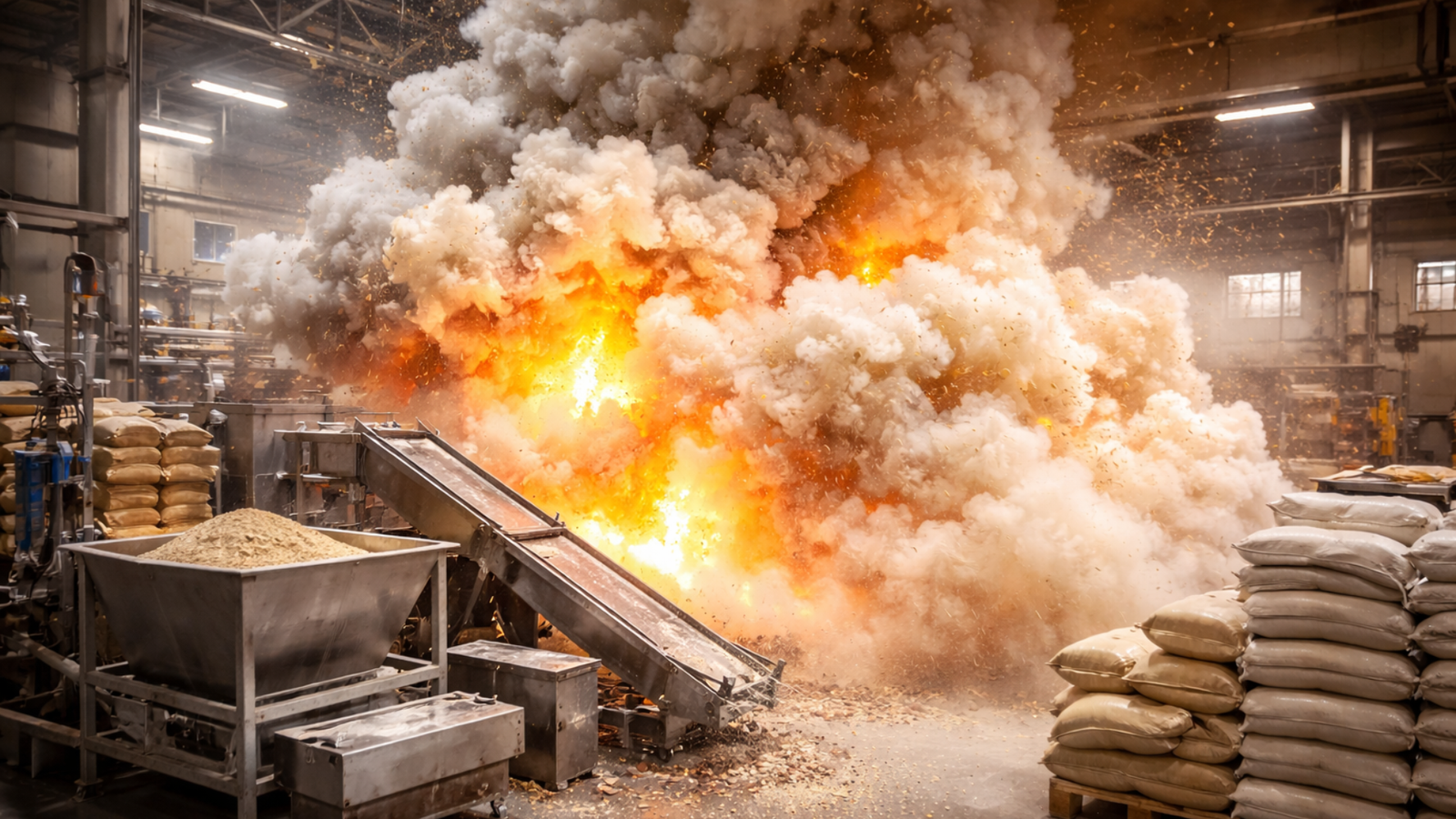
Grinding and material transfer generate dust.
A properly designed de-dusting system draws airborne particles away from the processing area and captures them using appropriate separation and filtration equipment.
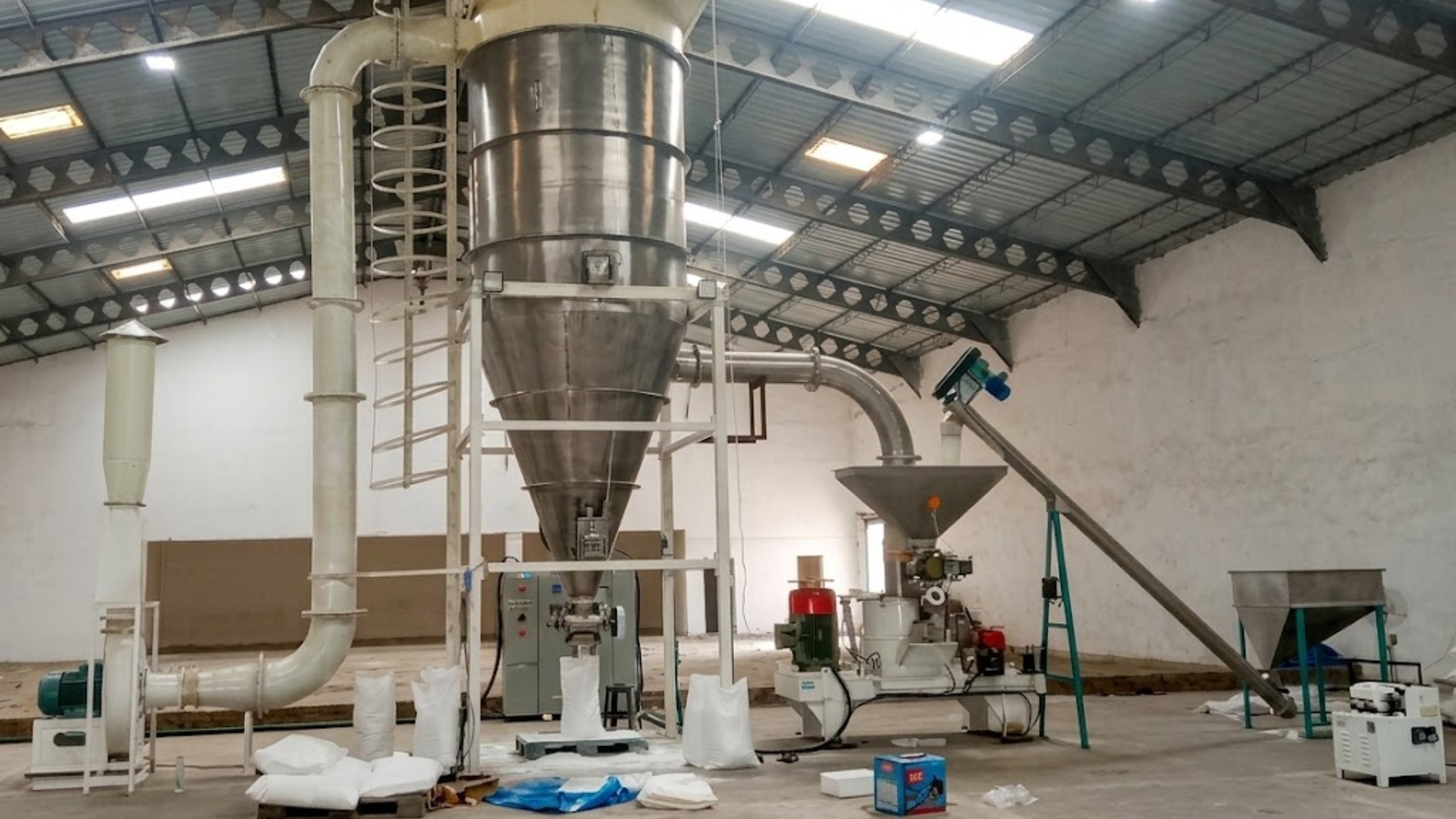
A typical arrangement can include a cyclone followed by a pulse-jet bag filter, depending on the process and particle characteristics.
The objective is twofold:
Protect the working environment and control airborne dust.
Recover product that would otherwise be lost from the process.
The recovered material should, however, only be returned to the product stream where the process design and quality system allow it.
Dust collection is therefore more than housekeeping.
It is part of process hygiene, worker protection and product-loss control.
Stage 8: Sifting and Final Classification
Depending on the process configuration, a final sifting stage may be used to confirm the required product size.
The purpose is to separate material that meets the specification from oversize particles.
In an ACM-based system, much of the particle-size control happens within the classifier itself. A downstream sifter may still be included where the customer’s specification or process design requires an additional separation step.
The important distinction is that classification and final sifting are not necessarily the same operation.
The classifier controls the grinding circuit.
The final sifter, where used, provides an additional product-quality check.
Stage 9: Delumping and Powder Handling
Fine turmeric powder can form agglomerates during storage, drying or transport.
These lumps do not necessarily mean that the original grinding specification was incorrect.
If the powder has already reached the required particle size, sending it through the grinding system again simply to break storage agglomerates can introduce unnecessary energy and processing.
This is where a Delumper can be useful.
MillNest’s MLUM is designed to break caked and agglomerated powder back into a free-flowing condition without deliberately changing the underlying particle-size specification. The company specifically lists turmeric among its caked spice applications.
The Delumper is therefore a handling solution, not a primary grinding machine.
Stage 10: Metal Detection and Packing
Before packing, the finished powder can pass through appropriate foreign-material controls, including metal detection where required by the food-safety plan.
Metal detection addresses metallic foreign-body risks. It should not be confused with chemical contaminant testing such as testing for lead chromate.
Once the product meets its specification, it should be packed using a system appropriate for the intended product and market.
The objective is to protect the powder from moisture, contamination and handling damage between the processing line and the customer.
Common Mistakes to Avoid
Treating the hammer mill as mandatory
Not every turmeric line needs a Hammer Mill as the first grinding stage.
The appropriate equipment depends on incoming feed size and the required finished product. MillNest’s current turmeric process uses controlled kibbling followed by ACM fine milling.
Selecting equipment without testing the actual turmeric
Turmeric varies between origins, varieties and batches.
A machine that performs well with one material may require different operating conditions with another.
Material trials are therefore valuable before final equipment selection.
Ignoring temperature
Temperature should be measured where it matters rather than assumed from the equipment name.
The objective is to establish a process window that achieves the required particle size without unnecessary thermal load.
Treating de-dusting as optional
Fine spice dust affects housekeeping, working conditions and product recovery.
De-dusting should be considered during the initial line design rather than added only after dust becomes a problem.
Using a delumper as a grinder
A delumper is intended to break agglomerates, not perform primary size reduction.
Its advantage is that it restores flowability while avoiding unnecessary regrinding.
Why the Stages Connect
The most important lesson in turmeric processing is that the stages are not independent.
Cleaning protects the equipment and product.
Curing and drying establish the condition of the raw material entering secondary processing.
Kibbling prepares the rhizome for fine milling.
ACM grinding and classification establish the required fine particle-size distribution.
Temperature management helps control the conditions under which the product is processed.
Sterilisation addresses microbial requirements where required.
Drying and cooling bring the treated material back to the appropriate condition.
De-dusting controls airborne powder and product loss.
Delumping restores flowability when agglomeration occurs.
Packing protects the finished product from the processing environment.
The result is a process in which every stage supports the next.
The Engineering Principle Behind a Good Turmeric Processing Plant
A good turmeric processing plant is not simply a collection of machines.
It is a sequence of controlled operations built around the raw material and the finished-product specification.
For one processor, that may mean controlled kibbling followed by fine ACM grinding.
For another, a Hammer Mill may be the appropriate solution for the required particle size and capacity.
For an export-oriented processor, sterilisation, drying, traceability and additional quality controls may become important.
For a fine-powder application, particle-size distribution and temperature management may take priority.
There is no single configuration that should be applied to every turmeric processor.
The engineering starts with a few basic questions:
What is the incoming feed size?
What is the moisture range?
What final particle size is required?
What throughput is required?
Is microbial reduction required?
What quality parameters does the buyer specify?
Is the product intended for conventional food, nutraceutical, export or another application?
Once those questions are answered, the appropriate process route becomes much clearer.
That is the real purpose of turmeric processing equipment.
The goal is not simply to make the rhizome smaller.
It is to move the material through a controlled sequence that produces a consistent, specification-ready powder while managing the factors that can affect quality along the way.