What you will learn
- Why the blender is the most important convergence point in a multiline spice plant
- What recipe management is and what problems it solves
- How to choose between a ribbon blender and a paddle blender for a blend
- How clean discharge and lot traceability protect every batch
The blender is where every line meets
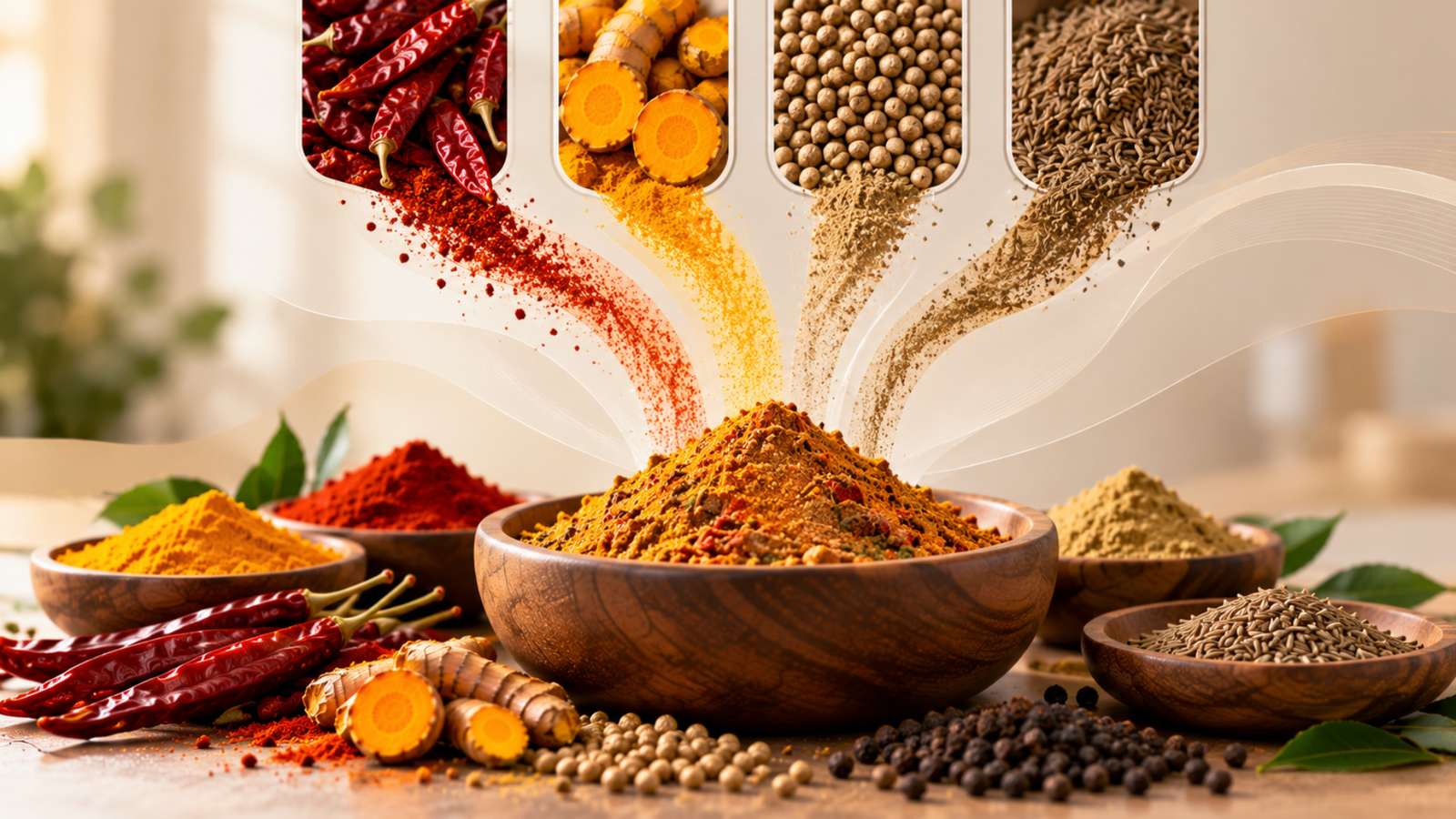
In a plant that makes masalas or seasoning blends, the work does not end when chilli, turmeric, coriander or cumin is ground. Each of those powders comes from its own line, often its own mill, each with its own settings. At the blender, they finally meet.
That makes the blender a special place in the plant. Every decision made upstream shows up here. If the coriander powder lost aroma on the way, the blend will taste flat. If the chilli was ground coarser than usual, the blend will look different. If an ingredient was added in the wrong amount or the wrong order, the whole batch is affected.
It also makes the blender the best place to control consistency, because it is the last point where the product can still be corrected before it is packed.
What a recipe really contains
Most people think of a recipe as a list of ingredients and quantities. In an industrial blending room, a recipe contains more than that:
- Ingredients and quantities — which powders go in and how much of each.
- Addition sequence — the order in which ingredients are added. Small-quantity ingredients are often added in a way that helps them spread evenly, rather than being dumped on top at the end.
- Mixing parameters — how long the blender runs and how it runs for that blend.
- Discharge instructions — how the batch leaves the blender and where it goes next.
When a recipe lives only in an operator’s notebook or memory, every one of these details can vary from shift to shift. One operator mixes a little longer. Another adds the salt before the chilli. A new operator reads a quantity wrong. None of these are dramatic mistakes, but together they are the reason two batches of the same masala can taste and look different.
What recipe management does
Recipe management means storing each blend’s recipe in the blender’s control system so that the blender runs it the same way every time. MillNest ribbon blenders (MRBL) and paddle blenders (MPBL) can be supplied with recipe management.
In practice this gives a plant three benefits.
1. Repeatability
The same blend runs with the same sequence and the same mixing parameters, regardless of who is on shift. The tenth batch of the day matches the first. A masala sold under a brand name tastes the same in every pack.
2. Faster, safer recipe changes
In a multiline plant, the blender may switch between several recipes in a day. Selecting a stored recipe is faster than setting up from scratch, and it removes the risk of carrying the previous recipe’s settings into the next blend.
3. Records
Each batch run against a recipe can be recorded. That record is the foundation of traceability, which we look at below.
Ribbon or paddle: choosing the right blender
Both blender types are common in spice plants. The right choice depends on the blend.
Ribbon blender (MRBL). A ribbon blender uses helical ribbons that move material in opposite directions along the trough, folding it together. It is widely used for free-flowing dry powders, which describes many masalas and spice mixes. MillNest offers food-grade ribbon blenders for spice mixing.
Paddle blender (MPBL). A paddle blender uses angled paddles to lift and move material. MillNest paddle blenders are engineered for challenging mixing tasks, including semi-solids, sticky materials and high-shear applications. The strategically angled paddles give even distribution with no dead zones, and the discharge design allows complete material removal. That makes paddle blenders a strong choice for seasoning powders and blends that include oil, sticky ingredients or ingredients that do not flow easily.
A simple rule for operators: if the blend is dry and flows freely, a ribbon blender usually suits it. If the blend contains oily, sticky or difficult ingredients, or if complete discharge between recipes is a priority, look at a paddle blender.
Clean discharge between recipes
In a single-product plant, a little residue left in the blender simply joins the next batch of the same product. In a multiline plant, the next batch is often a different recipe. Residue becomes carryover.
That is why discharge design matters so much. A blender that empties completely leaves less behind, needs less cleaning, and reduces the risk of one masala’s chilli or an allergen such as mustard ending up in the next. Good practice for operators:
- Discharge fully and confirm the blender is empty before starting the next recipe.
- Follow the cleaning step set for that recipe switch, especially when moving from a pungent, strongly coloured or allergen-containing blend to one without.
- Sequence recipes from mild to pungent and light to dark wherever possible.
- Record the clean.
Lot traceability: knowing what went into every batch
Imagine a customer reports a problem with one pack of masala. To investigate, the plant needs to answer a simple question: which batches of chilli, turmeric, coriander and every other ingredient went into that pack?
This is batch traceability, and in a multiline plant the blender is where it is either preserved or lost. Each single-spice powder arriving at the blender comes from a known lot on its own line. When the blend is made, those lot numbers need to be linked to the blend’s batch number.
With recipe management and batch records, the link is recorded at the point of blending: this blend batch used this recipe, these ingredient lots, at this time. If a problem appears later, the plant can trace it back to the specific ingredient lot and line, and check whether other blends used the same lot.
For export customers and large food manufacturers, this kind of traceability is increasingly expected, not optional.
How it fits the whole line
The blender is the last processing step in the multiline plant before packing. Upstream, each spice has been cleaned, sterilised (for example with HT-ST steam sterilisation at 102–122°C for 20–40 seconds, using technology from MillNest’s partner Therma Process), ground on a mill suited to it, sifted and moved through enclosed conveying. The blender brings these together, and recipe management makes sure they come together the same way every time.
Key takeaways
- In a multiline plant, the blender is where every upstream line meets, so it is the best point to control blend consistency.
- A recipe is more than ingredients: it includes sequence, mixing parameters and discharge.
- Recipe management stores recipes in the blender’s control so blends repeat reliably across shifts and recipe switches.
- Ribbon blenders suit free-flowing dry blends; paddle blenders suit sticky, oily or difficult blends and offer complete discharge.
- Complete discharge, sensible sequencing and recorded cleaning control carryover between recipes.
- Linking ingredient lots to blend batches gives full traceability.
Quick check
- Name three things a recipe contains besides ingredients and quantities.
- Why is residue in a blender a bigger concern in a multiline plant than in a single-product plant?
- A seasoning blend contains oil and tends to stick. Which blender type would you look at first, and why?
- What information needs to be recorded at the blender to trace a pack back to its ingredient lots?
CTA: Explore more lessons at MillNest Academy | Ask about MRBL and MPBL blenders with recipe management: enquiry@millnest.com